A corner is often the most wasted space in a room: too awkward for a bookshelf, too small for a sofa, and too easy to leave empty. A corner desk turns that awkward space into the most useful spot in the house. By fitting into two walls at once, it gives you a generous working surface without taking over the middle of the room, and it creates a natural sense of enclosure that helps many people focus. Whether you work from home full-time, study in the evenings, or simply need a proper place for a laptop that is not the kitchen table, a corner desk is worth considering before a conventional straight desk.
This guide covers what actually matters when choosing one: the shapes available, how to judge size against your room, the materials and build quality to look for, storage and cable management, and how to set the desk up so that it stays comfortable over a full working day. There are no specific measurements recommended here, because the right size depends entirely on your room, your equipment and your height. Instead, this guide explains how to measure and what to check, so that the desk you buy fits your space rather than fighting it.
Why a Corner Desk Works So Well
The appeal of a corner desk is partly practical and partly psychological. Practically, a corner gives you two runs of surface at right angles, so you can keep your main work in front of you and your reference material, printer or second screen to one side, without stacking everything in a single line. That spread matters more than it sounds: a straight desk of the same total length forces you to reach further sideways, while a corner desk keeps everything within a comfortable turn of the chair.
Psychologically, a corner creates a defined workspace inside a room that does other things. When the desk sits in a corner, the rest of the room remains a bedroom, a living room or a spare room, and the desk area reads as a place for work. That boundary helps at the end of the day, too. You can turn the chair away, close the laptop, and leave the work corner behind, rather than living with a desk that dominates the room you relax in. For households where space is shared, that separation is often the difference between a setup that lasts and one that gets dismantled within a month.
Shapes: L-Shaped, Curved and Compact Corners
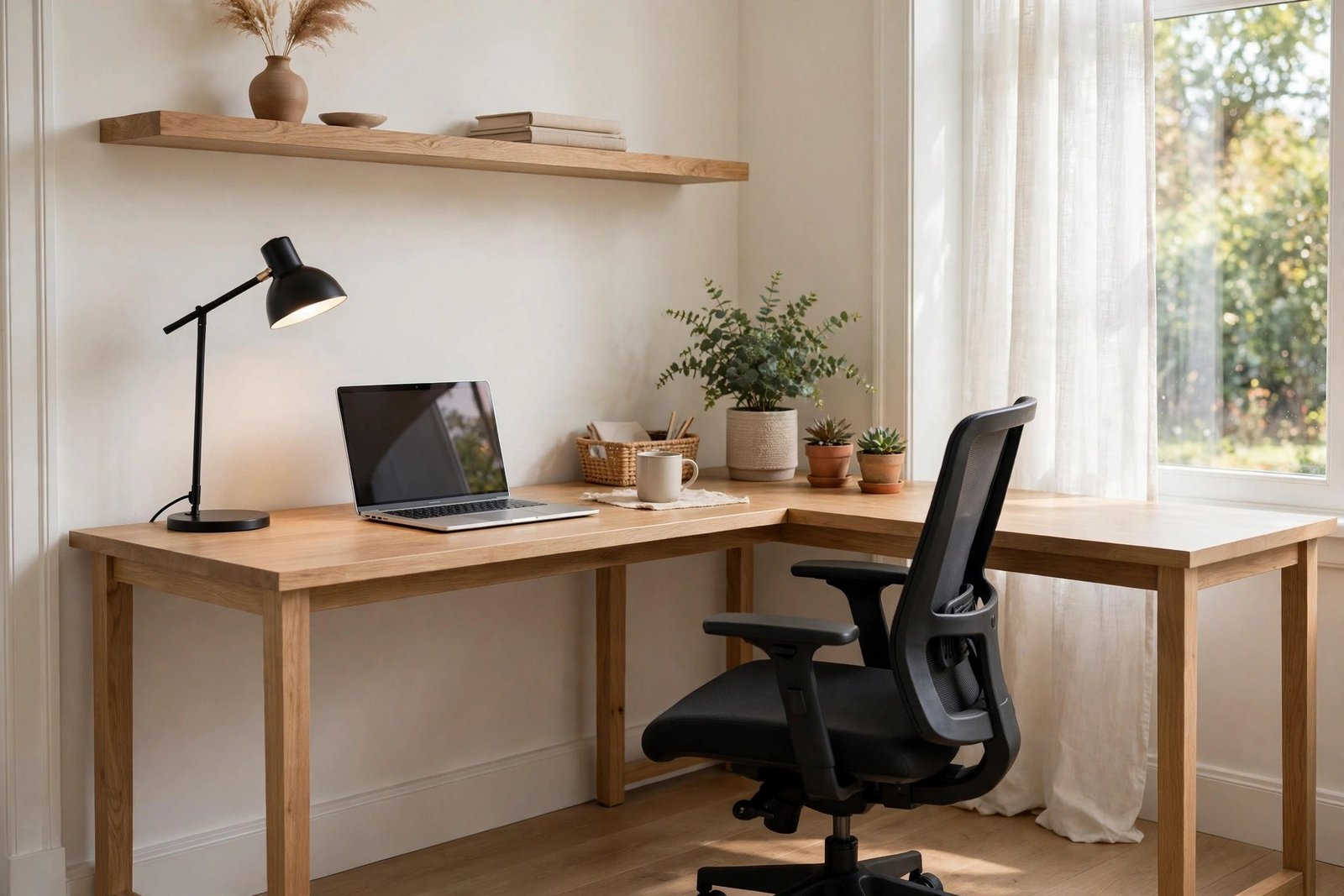
Most corner desks fall into a few broad shapes, and the shape decides how the desk feels to use. The classic L-shaped desk has two straight runs meeting at a right angle. It is the most flexible shape, because each arm can hold a different job: writing and typing on one side, paperwork or a second screen on the other. It also suits rooms where the corner is a true right angle with clear wall space on both sides. Check, though, that the join is genuinely usable and not blocked by a chunky leg or a support panel exactly where your knees need to go.
Curved corner desks soften that right angle with a rounded front, which can feel more comfortable if you sit in the corner itself and swivel between tasks. They suit people who work with a wide monitor or who like to sit centrally and turn to each side. Compact corner desks, by contrast, are designed for small rooms and small corners: shorter arms, shallower depth, and often a simpler frame. They are a good answer to a box room or a bedroom corner, provided you are honest about what must fit on them. A compact desk that cannot hold your monitor at a comfortable distance is not a bargain, however little space it takes.

A few designs add a raised shelf or a hutch above one arm. These can be useful for books and small items, but they also change the feel of the corner, making it more enclosed and sometimes darker. Before choosing one, think about light: a tall unit on the side where daylight comes from can throw your working area into shadow. In a small room, open shelving above the desk usually keeps the corner feeling lighter than a closed cupboard, while still giving you somewhere to put the things you reach for daily.
Getting the Size Right for Your Room
Size is where most corner desk purchases go wrong, and the mistake is almost always made before measuring. Start with the room, not the desk. Measure both walls from the corner outwards, and note anything that will interrupt the desk: skirting boards, radiators, plug sockets, window sills, doors that swing into the space, and wardrobes or drawers that need to open. A desk that fits the wall measurement but blocks a radiator or covers the only sockets in the corner will cause daily frustration.
Next, think about depth as well as length. Depth decides whether your monitor sits at a comfortable viewing distance, whether there is room for a keyboard in front of it, and whether papers or a notebook can sit beside the keyboard without being pushed off the edge. A desk that is too shallow forces you to sit too close to the screen or to perch the keyboard at an awkward angle. A desk that is too deep, on the other hand, wastes floor space and puts the back of the desk out of reach. If you use a large monitor, a monitor arm, or a laptop on a stand, allow for that in your thinking rather than assuming the screen will sit flat on the surface.
Chair space matters just as much as desk space. You need room to push the chair back, to swivel between the two arms of the desk, and to stand up without shuffling sideways. In a tight corner, test this with tape on the floor before ordering: mark the footprint of the desk you are considering, place your chair inside it, and try the movements you will make all day. It takes a few minutes and prevents the most common disappointment, which is a desk that fits the walls but leaves no room to actually work at it.
Materials and Build Quality
Corner desks are made from a range of materials, and each has a character worth understanding. Solid wood looks warm, ages well, and can usually be repaired if it is scratched or marked, but it is heavier and needs more care around drinks and damp. Wood veneer over a sturdy core gives much of the same look at a lower weight, provided the veneer is well finished and the edges are properly sealed. Laminate surfaces are practical and easy to wipe clean, and they come in a wide range of finishes, but cheaper laminates can chip at the edges and show damage more plainly.
Metal frames with a wood or laminate top are a common combination, and they often give the best balance of strength and lightness, especially for larger L-shaped desks that need to stay rigid across a long span. Whatever the material, check the structure before the surface: how the two arms join, whether the frame wobbles when pressed at the far end, how the legs or panels are fixed, and whether the desk can be levelled on an uneven floor. A desk that rocks will annoy you every day, and no attractive finish compensates for a frame that flexes when you type.

Weight capacity is worth checking in general terms, particularly if the desk will hold a heavy monitor, a printer, books, or a desktop computer. The stated capacity of a desk is only useful if it describes the whole desk rather than a single shelf, so read it carefully and think about the total load across both arms. A corner desk is also only as good as its assembly: clear instructions, fixings that do not strip on first use, and a design that can be taken apart and rebuilt if you move house are all signs of a desk made to last rather than made to photograph well.
Storage, Cables and the Details That Matter Daily
A corner desk generates cables from two directions, and without a plan they quickly become a tangle behind the desk that is hard to reach. Look for a cable tray, a cable hole in each arm, or at least a gap at the back that lets cables drop neatly to a power strip on the floor. Think about where your sockets are before you choose which arm holds the computer, because a desk arranged against the sockets is far easier to live with than one that needs extension leads trailing across the room.
Storage needs honesty. Drawers built into a corner desk are useful, but a drawer unit under one arm can eat into legroom, and a pedestal that blocks the swivel between arms defeats the point of the corner shape. Many people do better with storage beside the desk, such as a small set of drawers or a shelf unit that sits alongside one arm, leaving the desk itself clear for work. Whatever you choose, keep the surface rule in mind: a desk that starts clear and gradually fills with clutter is a storage problem, not a desk problem, and solving it with a drawer or shelf you will actually use is worth more than a larger desk you will simply fill further.
Height is the other daily detail. A fixed-height desk suits most adults, but if several people of different heights share the desk, or if you like to alternate between sitting and standing, an adjustable-height frame is worth considering. Even with a fixed desk, the chair does much of the work: a chair that adjusts in height, with proper support for your back, will do more for comfort than any desk feature. Set the combination up so that your eyes meet the top portion of the screen without hunching, your forearms rest comfortably, and your feet sit flat, and you will have a workspace that stays comfortable well beyond the first week.
Setting Up Your Corner Workspace
Once the desk is in place, arrangement makes the difference between a corner that works and one that merely fits. Put your main task in front of you, not in the corner itself, unless you genuinely sit facing the corner and like that position. Many people prefer to sit along one arm, facing the wall, with the second arm as supporting space to the side. That arrangement gives a clear view, keeps daylight from glaring directly onto the screen, and leaves the corner join free for a lamp, a plant, or reference material.
Light deserves a moment of planning. Natural light from a side window is ideal, but a screen facing directly into bright daylight will glare, and a screen with its back to a window will leave you squinting at a bright background. A desk lamp with adjustable direction solves most of this, and it also makes evening work far more comfortable than a single ceiling light. Keep the lamp on the side opposite your writing hand where possible, so that your hand does not cast a shadow over your work, and keep the brightest light off the screen itself.

Finally, give the corner a finish that makes you want to sit there. A plant, a picture on one wall, a comfortable chair and a clear surface at the start of each day all sound like decoration, but they are really about habit: a workspace that feels pleasant is one you will use, and one you will keep tidy. A corner desk that becomes a dumping ground for laundry and unopened post has failed, however well it was chosen. A short end-of-day reset, clearing the surface and putting papers away, keeps the corner ready for the next morning and protects the investment the desk represents.
A Corner Desk and the Wider Home
A desk is rarely bought in isolation. It is part of a home that also has to work for rest, family life and the future. If you work from home on a self-employed basis, for example, the desk is also part of your working records: keeping receipts and notes about equipment and workspace costs in an organised way makes the annual paperwork far simpler, as explained in our guide to the self assessment tax return. That guide is general information rather than personal tax advice, but it is a useful reminder that a home office is a working arrangement, not just furniture.
Paying for a desk is another wider-home question. Some people save and buy outright, while others spread the cost, and the cost of borrowing in general is something to understand before committing to any form of credit, as explained in our guide to interest rates. The guide gives no current figures, because rates change, but it explains the concepts that decide what borrowing actually costs over time, which is the right question to ask before choosing how to pay. And a desk chosen for a home you plan to live in for years is also part of a longer story about the home itself, including how a home and its contents fit into wider family and estate planning, a subject covered in general terms in our guide to inheritance tax. None of these guides replaces professional advice, but together they are a reminder that a home office sits inside a household budget and a household future, not apart from them.
Common Mistakes to Avoid
- Buying before measuring: Wall lengths, sockets, radiators, doors and chair space all need checking before the desk is ordered, not after it arrives.
- Choosing depth by looks alone: A shallow desk may photograph beautifully and still leave no room for a monitor at a comfortable distance.
- Blocking the swivel: A drawer unit or support panel in the wrong place can stop you turning between the two arms, which removes the point of a corner.
- Ignoring cables: Plan where power comes from and how cables will run, or the back of the desk will become a tangle within a week.
- Forgetting light: A tall unit on the daylight side, or a screen facing straight into glare, will make the corner unpleasant to use.
- Overfilling the surface: More desk does not solve clutter. Storage beside the desk, and a daily reset, keep the working surface clear.
Frequently Asked Questions
Is a corner desk better than a straight desk?
It depends on your room and your work. A corner desk gives more usable surface in less floor space and creates a defined workspace, which suits small rooms and people who spread work across two areas. A straight desk suits a long wall, a single focused task, or a room where the corner is needed for something else.
Will a corner desk fit in a small bedroom?
Often, yes, because it uses space that would otherwise be wasted. The key is a compact design with honest dimensions: measure the corner, allow for chair movement, and check that the desk depth still leaves a comfortable monitor distance. A compact desk that fits is better than a large desk that crowds the room.
Can I sit in the corner itself, or along one arm?
Both work, and the choice is personal. Sitting in the corner with a curved desk suits swivelling between tasks. Sitting along one arm, facing the wall, suits focused work with supporting space to one side. Try both positions with a chair and a laptop before fixing monitors and cables in place.
Do corner desks work for two monitors?
Yes, and this is one of their strengths. One monitor can sit on each arm, or both can sit along the longer arm, depending on the shape. Check the depth and the sturdiness of the desk, and consider a monitor arm, which frees surface space and lets you adjust position easily.
What should I check before ordering online?
The assembled footprint, the depth of each arm, the usable space at the join, the frame construction, the weight capacity across the whole desk, and how cables and levelling are handled. If any of those details is missing from the listing, ask before ordering rather than discovering the gap on delivery day.
Conclusion
A corner desk is a practical answer to a common problem: how to create a proper workspace in a room that must do other things as well. Choose the shape that matches how you work, measure the room and the chair space before you measure the desk, check the frame and the join before the finish, and plan for cables, light and storage from the start. Done that way, the corner stops being wasted space and becomes the most productive spot in the house: a place with room to spread out, a clear boundary between work and rest, and a setup comfortable enough to use every day. The best corner desk is not the largest or the most elaborate one. It is the one that fits your room, holds your equipment without strain, and leaves you wanting to sit down and get on with the work.