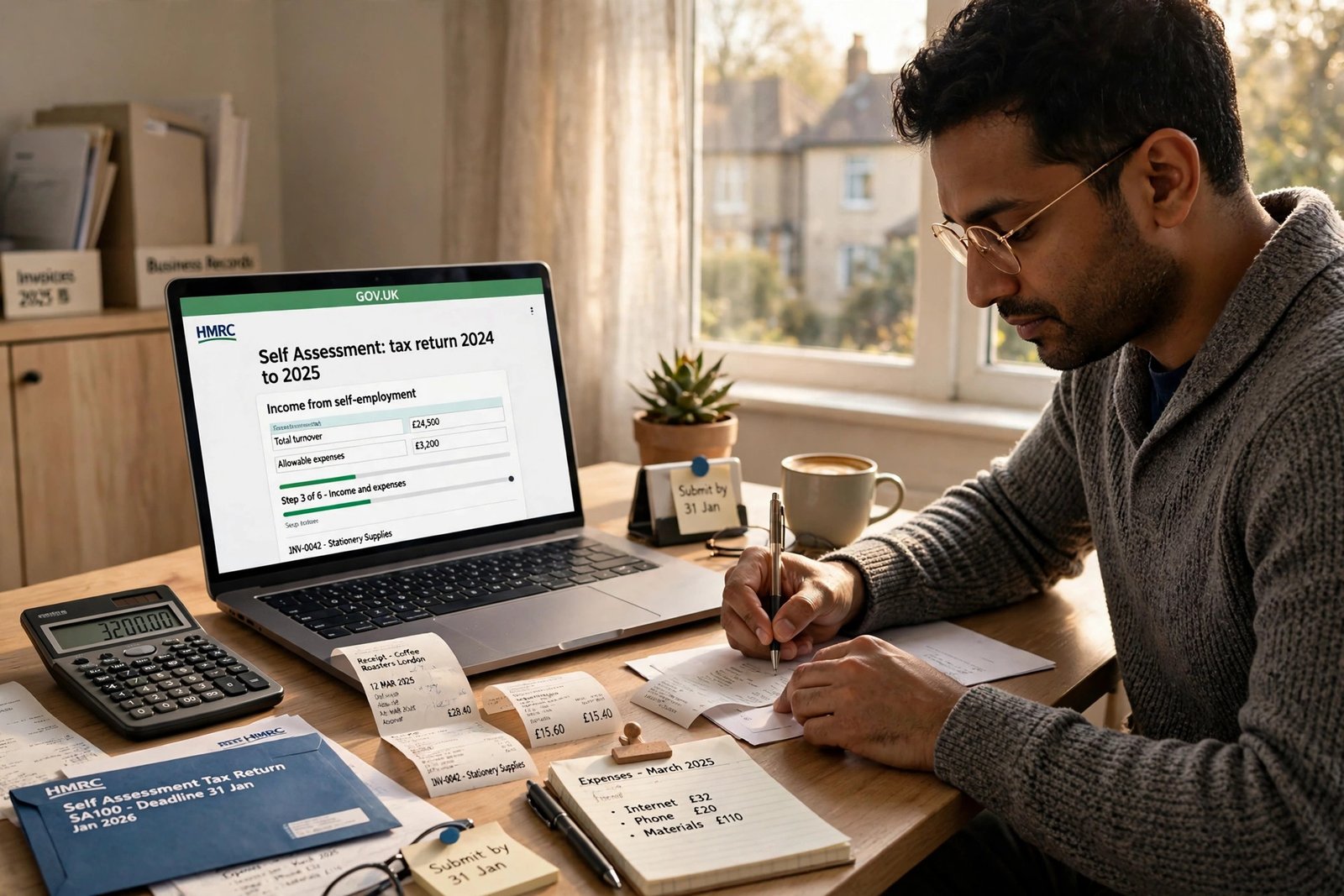
If you are self-employed, earn income outside a regular salary, or have untaxed earnings in the UK, you will almost certainly meet the self assessment tax return sooner or later. It is the system HMRC uses to collect income tax from people whose tax is not automatically taken from their pay. For many first-timers it sounds far more frightening than it is. The form itself is mostly a matter of adding up what you earned, subtracting what you are allowed to claim, and sending the result to HMRC on time.
This guide explains the whole process in plain English: who needs to file, what the deadlines are, what to gather before you start, how to work through the return step by step, and the mistakes that most often lead to penalties. It is general information, not personal tax advice, so speak to a qualified accountant if your situation is complicated.
What Is a Self Assessment Tax Return?
Most UK employees never see a tax return because their employer deducts income tax and National Insurance through PAYE before they are paid. Self Assessment exists for everyone else. If your income is not taxed at source, HMRC asks you to report it yourself once a year so it can work out the tax you owe.
The return covers a tax year, which in the UK runs from 6 April one year to 5 April the next. You report all of your income for that year: self-employed profits, rental income, savings interest above the relevant allowances, dividends, capital gains, and any other untaxed income. You also claim the expenses and reliefs you are entitled to, and HMRC calculates the final bill — or, if you have overpaid, the refund.
There is an important distinction to keep in mind. A self assessment tax return is for individuals, including sole traders and partners. If you run a limited company, the company itself does not file Self Assessment at all. That is a different system, explained in our guide to corporation tax, and it is one of the reasons people compare the two structures before deciding how to run a business.
Who Needs to File One?
You generally need to file if any of the following apply to you:
- You are self-employed as a sole trader and your trading income is above the threshold HMRC sets for filing.
- You are a partner in a business partnership, even if the partnership itself also files a return.
- You earn rental income from property you own.
- You have savings or investment income that has not already been taxed, such as dividends above the dividend allowance.
- You have capital gains from selling assets such as shares or a second property.
- You claim certain reliefs or allowances that can only be handled through a return, or HMRC has asked you to file for another reason.
Contractors are a special case worth a mention. If you work through your own limited company, your company deals with its own taxes and you do not file a self assessment tax return for that company income in the same way. But whether you are inside or outside the off-payroll rules changes how you are taxed, and our guide to the IR35 rules explains that decision in plain English. If you are unsure which side of the line you fall on, that is exactly the kind of question an accountant can settle quickly.
If you are not sure whether you need to file, HMRC provides an online checker that asks a short series of questions and gives you an answer. It is worth using before you assume either way, because both failing to file when you should and filing unnecessarily waste your time.
Key Dates and Deadlines
Deadlines are the part of Self Assessment that causes the most penalties, so put them in your calendar as soon as you register. The two that matter most are:
- Registering for Self Assessment: you must tell HMRC you need to file by early October following the end of the tax year. For a first return this is the step people most often miss, because they assume filing starts with the form.
- Filing online and paying: the online return and any tax owed are both due by 31 January following the end of the tax year. Paper returns have an earlier deadline in the autumn.
Those dates are fixed, and HMRC charges penalties for missing them even if you owe no tax at all. The penalty system starts with a fixed charge for a late return and grows the longer the delay continues, with additional interest on any tax paid late. If you think you will miss a deadline, contact HMRC before it passes rather than after. It is always better to file something on time and correct it later than to file nothing at all.
One practical tip: do not leave the return until January. The online service gets busy, accountants get booked up, and any missing document takes longer to chase in the Christmas period. People who file in the autumn usually find the whole thing far less stressful.
What You Need Before You Start
Before you open the form, gather everything the return will ask for. Having it in one folder — physical or digital — saves most of the frustration. You will typically need:
- Your Unique Taxpayer Reference (UTR), which HMRC sends when you register, plus your Government Gateway login details.
- Records of all your income for the tax year: invoices, bank statements, P60 or P45 forms if you also had employment, rental statements, dividend vouchers, and interest statements from banks or building societies.
- Records of allowable expenses: receipts and invoices for costs you incurred wholly and exclusively for your work, such as equipment, software, travel, office costs, and professional fees.
- Details of any reliefs you plan to claim, such as pension contributions or charitable donations made under Gift Aid.
- Last year’s return, if you have one, because it reminds you what you claimed before and keeps your figures consistent.
Good record-keeping is not just about making filing easier. HMRC can ask to see your records after you file, and you are expected to keep them for a set period after the return. A simple system — one folder per tax year, with income and expenses filed separately — is enough for most small businesses, and accounting software can automate much of it once you are set up.
Filling In the Return, Step by Step
Once your documents are ready, the return itself follows a logical order:
- Confirm your personal details. Check your name, address, National Insurance number and UTR. Errors here cause delays out of all proportion to their size.
- Declare each source of income in turn. The online form splits this into sections — employment, self-employment, property, savings, dividends, and capital gains — so you only complete the sections that apply to you.
- Enter your expenses for each source. For self-employment this is where most of the work sits: list your allowable costs carefully and keep the receipts to back them up.
- Claim reliefs and allowances. Work through pension contributions, Gift Aid donations, and any other reliefs that apply. The form prompts you, but it cannot know about a relief you forget to mention.
- Review the calculation. Before you submit, the system shows how much tax it thinks you owe. Read it. If the figure looks wildly different from what you expected, go back and check for a missing income source or a mistyped number — a single extra zero is the most common cause of a shock bill.
- Submit and save the confirmation. Keep the submission receipt and a copy of the completed return. Your tax is usually payable by the same January deadline, so check the payment options and pay in good time.
One feature that surprises first-timers is payments on account. If your bill is large enough, HMRC may ask you to pay part of next year’s tax in advance, in two instalments. This is not an extra charge — it is an advance against next year’s bill — but it does mean your January payment can be larger than you expect. The calculation on screen will show it clearly, so read it before you assume the figure is wrong.
What Happens After You File
After submission, HMRC processes the return and confirms the amount due. If you have paid too much, a refund follows. If you owe tax, you pay by the January deadline using one of HMRC’s payment methods, such as bank transfer or debit card. Keep proof of payment alongside your return.
HMRC may also open an enquiry into a return, which sounds alarming but is usually a request for clarification or for a specific document. Responding promptly and completely is the fastest way to close it. Good records, kept from the start, make an enquiry a minor inconvenience rather than a crisis.
Finally, set yourself up for next year. Note anything that was hard to find this time — a missing statement, an unrecorded expense — and fix the system now. A small monthly habit of filing invoices and logging expenses beats a frantic January every time.
Common Mistakes to Avoid
- Missing the registration deadline. You cannot file until you are registered, and registration itself takes time because HMRC posts you an activation code.
- Forgetting an income source. Small amounts of rental, savings or freelance income still count, and HMRC receives much of this information independently.
- Claiming personal costs as business expenses. Only costs incurred wholly and exclusively for the business qualify. Mixed costs need careful apportioning.
- Typing errors. A misplaced decimal point or an extra digit can double a bill or hide income. Always review the final calculation.
- Leaving it to January. The later you start, the less room you have to fix problems, and accountants are hardest to reach when everyone else is panicking too.
- Ignoring payments on account. Budget for them, or January will bring an unwelcome surprise.
Frequently Asked Questions
Do I need to file a Self Assessment tax return if I am employed?
Usually not, because your employer handles your tax through PAYE. You may still need to file if you have additional untaxed income, such as rental income, significant savings interest, or freelance earnings alongside your job.
What happens if I file late?
HMRC charges an automatic penalty for a late return, even if you owe no tax, and the penalties and interest grow the longer the delay continues. File on time even if you cannot pay in full, and contact HMRC about payment options.
Can I correct a return after submitting it?
Yes. You can amend an online return within a set period after filing, usually up to a year after the filing deadline. If you spot an error, correct it promptly rather than hoping HMRC will not notice.
Do I need an accountant to file Self Assessment?
No, many people with straightforward affairs file themselves using HMRC’s online service. An accountant becomes worth it when your affairs get complicated — multiple income sources, property, capital gains, or a company alongside self-employment.
How long should I keep my tax records?
HMRC expects you to keep records for a set period after you file, and the exact period depends on your situation. Keeping at least a full tax year’s records in one place, and longer for property or capital gains, is a safe habit.
Conclusion
A self assessment tax return is mostly organisation, not expertise. Register in good time, keep your records in one place through the year, work through the form section by section, and check the final calculation before you submit. Do those four things and the January deadline becomes routine rather than stressful. And if your situation involves a company, contracting arrangements, or anything you are unsure about, a short conversation with an accountant before you file is almost always cheaper than fixing a mistake afterwards.